How to Know if You Need a New Roof: The Ultimate 2026 Homeowner Checklist
What if the $15,000 quote you received for a full replacement is actually just a $450 flashing repair? For many Texas homeowners, the uncertainty of how to know if I need a new roof leads to sleepless nights and unnecessary financial strain. You’ve likely felt that familiar knot in your stomach after a heavy storm, wondering if those few missing shingles are a minor cosmetic issue or the first sign of catastrophic water damage. It's completely normal to feel cautious about contractor advice. Your home is your most significant investment and deserves steadfast protection.
At Pro Roofing Systems, we’ve spent 35 years providing the expert guidance necessary to safeguard your property. This guide replaces guesswork with a clear "yes or no" framework to determine your roof's true condition. You will learn to spot the seven critical warning signs of failure, understand how 2026 material standards impact your ROI, and gain the assurance needed to make an informed decision. We are breaking down our professional checklist so you can stop worrying about hidden leaks and start feeling confident in your home’s resilience.
Key Takeaways
- Evaluate your roof's age against the 20-year benchmark and learn how professional installation quality impacts the long-term resilience of your home.
- Master the expert checklist on how to know if I need a new roof by identifying critical shingle warning signs like curling, cupping, and moisture entrapment.
- Uncover hidden structural vulnerabilities by performing targeted attic inspections for light leaks and sagging lines that threaten your home’s interior.
- Understand how the intense "Texas Toaster" climate accelerates material aging and why Central Texas homes require specific thermal protection strategies.
- Apply the "25% Rule" to make a steadfast decision between cost-effective repairs and a full replacement to ensure your property remains protected for years to come.
Evaluating Roof Age and Material Lifespan
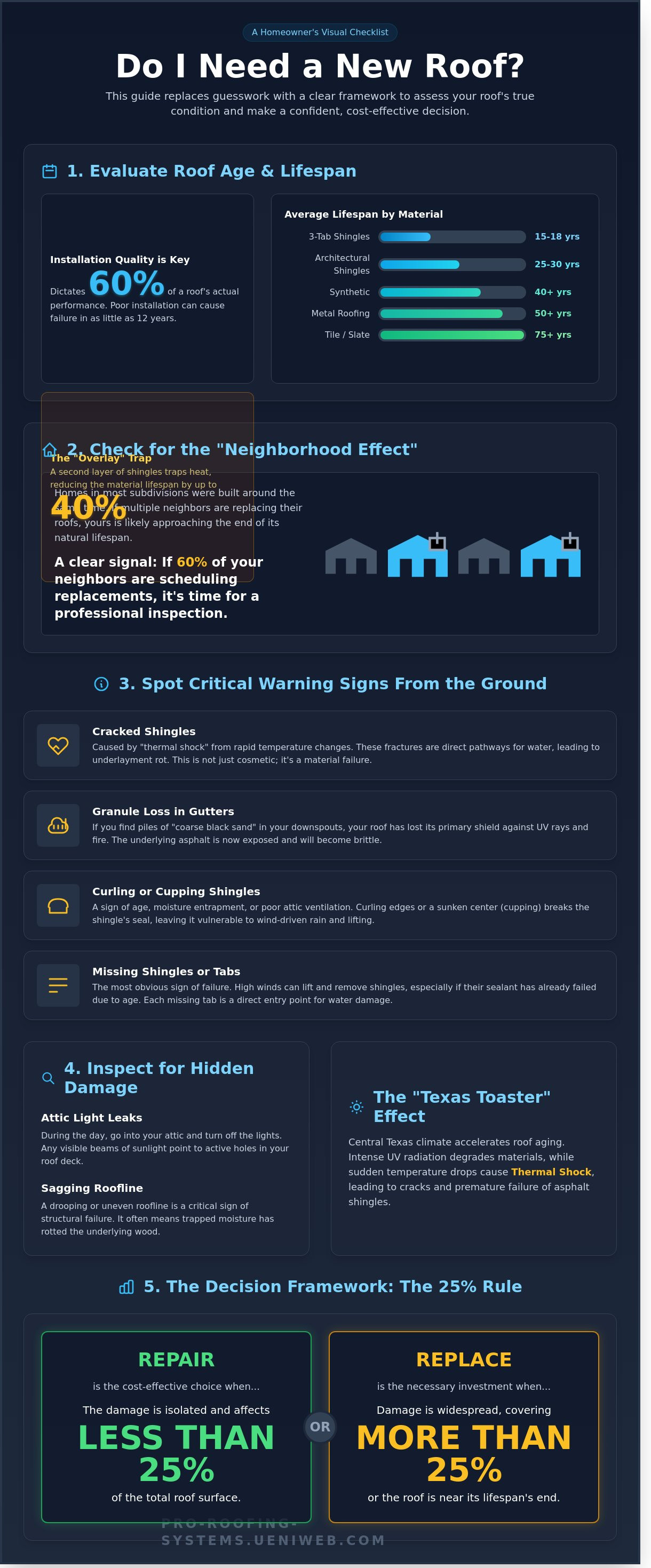
Determining the exact age of your home's exterior is the first step in learning how to know if I need a new roof. While many homeowners rely on a 20-year rule of thumb for asphalt shingles, this benchmark is rarely a fixed guarantee. Our 35+ years of Texas expertise shows that installation quality dictates 60% of a roof's actual performance. A system installed without proper ridge ventilation or with incorrect nailing patterns can fail in as little as 12 years, even if the shingles themselves have a longer manufacturer warranty.
If your current roof was installed as an "overlay" (shingles placed directly over an older layer), you're facing a shortened timeline. These double-layered systems trap heat and prevent the top shingles from cooling, often reducing the material's lifespan by 40%. By 2026 standards, these installations are considered outdated and often fail to meet modern wind-resistance codes. Upgrading to a single, high-quality layer provides the protection and structural integrity your home requires.
Average Lifespan by Material Type
The durability of your home depends heavily on the specific commercially available roofing materials chosen during the last replacement. Traditional 3-tab shingles typically offer 15 to 18 years of reliable service before the granules begin to shed. Modern architectural shingles provide a more resilient profile, often lasting 25 to 30 years under normal conditions.
In the Austin area, metal roofing has become a steadfast choice for its 50-year lifespan and ability to reflect intense UV rays. While tile and slate can last 75 years or more, they require significant structural support. Synthetic alternatives now offer a similar aesthetic with a 40-year assurance, providing a lightweight yet durable solution for modern homeowners.
The "Neighborhood Effect" Warning Sign
Your neighbors' home maintenance habits provide a reliable statistical indicator for your own property. Most subdivisions are built within a tight 12-month window, meaning the homes on your street likely share the same original roof age. If you notice 60% of your neighbors are scheduling replacements, it's a clear signal that your materials are reaching their natural expiration.
Localized weather events are the primary driver of this trend. For example, the severe hailstorms that hit Austin in April 2024 impacted entire zip codes simultaneously. If your street was in the path of 2-inch hail, your roof's age effectively accelerated by a decade in a single afternoon. Evaluating your home's condition relative to the surrounding houses is a critical factor in how to know if I need a new roof before a minor leak becomes a major interior expense.
5 Critical Shingle Warning Signs to Watch For
Homeowners don't always need a ladder to spot trouble. A pair of high-powered binoculars allows for a safe ground-level inspection of your roof's current state. Look for shingles that appear distorted or uneven against the roofline. These visual cues are often the first indicators of how to know if I need a new roof before a major leak occurs. Identifying these issues early is part of a steadfast strategy to protect your investment and ensure long-term security.
Cracked shingles often result from thermal shock. This happens when temperatures fluctuate 40 degrees or more within a single 24-hour period. This stress causes the asphalt to expand and contract until it fractures. According to the Insurance Institute for Business & Home Safety, identifying these 8 signs you might need a new roof early can prevent costly structural wood rot. Learning how to know if I need a new roof involves recognizing that these physical changes are not just cosmetic; they represent a failure in the material's ability to shed water effectively.
Granule Loss and Gutter Debris
Your shingles rely on a layer of ceramic granules to reflect UV rays and provide fire resistance. When these granules wash away, your roof loses its primary protective shield. Granule loss is the final stage of shingle decay. If your downspouts are discharging what looks like coarse black sand, your roof's resilience is compromised. While 5 percent shedding is normal for new installations, heavy accumulation in older roofs suggests the asphalt mat is now exposed to brittle-inducing sunlight. This degradation leaves the underlying structure vulnerable to the elements.
Physical Deformities: Curling, Clawing, and Missing Tabs
Age and moisture trapment cause shingles to physically deform over time. Cupping occurs when the center of the shingle sinks while the edges rise. Curling happens when the edges turn upward, often due to poor attic ventilation or excessive heat. Both conditions leave the underlayment vulnerable to wind-driven rain. High winds exceeding 60 mph can also lift the sealant strips, leading to missing tabs. Once the seal is broken, the shingle's wind resistance drops by 40 percent. If you notice these deformities during your inspection, a professional roof assessment can determine if a repair or full replacement is necessary to safeguard your home.
Detecting Hidden Structural and Interior Damage
The attic serves as the most reliable diagnostic tool for your home's health. When homeowners ask how to know if I need a new roof, the answer usually lies in the structural bones of the house. Step into your attic on a bright day and turn off the lights. If you see pinpricks of daylight through the roof boards, you have active gaps that allow moisture and pests to enter. This isn't a minor issue. It's a clear sign that your decking has compromised integrity and requires immediate attention to safeguard your investment.
Check the roof line for sagging from a distance. A straight ridge is a sign of health; a dip or curve suggests that moisture has saturated the internal rafters or the OSB decking. This structural rot often stems from poor ventilation. Industry data shows that nearly 90% of attic spaces fail to meet modern airflow standards. Trapped heat can reach 150 degrees during peak summer months, effectively baking your shingles from the inside out and shortening typical roof lifespans by as much as 10 years. Our seasoned experts focus on these airflow dynamics to ensure your next roof performs at its best year-round.
Attic and Ceiling Red Flags
Water stains on your ceiling are deceptive. Gravity causes water to run along rafters, meaning a leak visible in the kitchen might originate from a chimney 15 feet away. Look for dark streaks or "blooming" plaster on the underside of the roof deck. If you smell a musty, earthy odor, mold is likely colonizing your plywood. Saturated fiberglass insulation is another critical warning sign. Once insulation gets wet, it loses up to 40% of its thermal resistance. This spike in your monthly energy bill is often the first financial indicator of a failing roof system.
Flashing and Pipe Boot Integrity
Flashing is the primary defense for your roof's most vulnerable points. These metal strips around chimneys, dormers, and vents represent 80% of all residential roof leaks. Inspect these areas for rusted metal or cracked seals. Many amateur repairs rely on "caulk-only" fixes. This is a temporary patch that fails within 12 to 24 months due to thermal expansion. True protection requires professional-grade metal replacement. If your pipe boots are cracked or the rubber is dry-rotted, you're one storm away from a major interior disaster. Understanding these mechanical failures is essential when deciding how to know if I need a new roof before the damage reaches your living room walls.
How the Austin Climate Accelerates Roof Aging
Austin's weather is notoriously harsh on residential building materials. The "Texas Toaster" effect describes how our relentless summer heat literally bakes the life out of asphalt shingles. When ambient temperatures hit 100°F for 40 or more days annually, your roof surface can soar to 160°F. This extreme heat evaporates the essential oils that keep shingles flexible. Without these oils, the asphalt becomes brittle and prone to cracking under the slightest pressure.
Thermal expansion and contraction cycles add another layer of stress to local homes. Central Texas often sees 30 to 40 degree temperature drops within a single 24-hour period. These rapid shifts cause your roof deck and shingles to expand and contract at different rates. Over time, this constant movement loosens fasteners and creates gaps in the flashing. Understanding these local environmental factors is a key part of how to know if I need a new roof before a minor leak becomes a structural failure. High UV radiation acts as a silent killer for roofing adhesives; it breaks down the chemical bonds that hold your shingles in place during high wind events.
The Aftermath of Central Texas Hail Storms
Identifying "hail hits" is difficult from the ground because they often appear as small, dark "bruises" rather than obvious holes. These soft spots represent areas where the protective granules have been crushed into the asphalt mat. Most Texas insurance policies require you to file a claim within a 12-month window following a documented storm event. Ignoring these small impact points today often results in major leaks within 24 months as the exposed asphalt degrades under the sun.
UV Degradation and Shingle Brittleness
Constant UV exposure causes shingles to lose their ability to shed water effectively. In Austin, south-facing roof slopes typically fail 3 to 5 years earlier than northern slopes because they endure the most direct solar radiation. If your south-facing shingles look "bald" or feel like crackers when touched, it's a clear sign of advanced age. Upgrading to "cool roof" technologies, which reflect up to 65% of solar energy, can significantly extend your system's lifespan in our climate.
The "Repair vs. Replace" Decision Framework
Deciding whether to patch a leak or invest in a full tear-off is the most critical step in determining how to know if I need a new roof. Most homeowners follow the "25% Rule." If the cost of professional repairs exceeds 25% of the total replacement value, a new installation is the smarter financial choice. In the 2026 real estate market, a new roof provides a substantial return on investment, often recouping 61% to 68% of its cost during a home sale. This isn't just about aesthetics; it's about structural assurance. A seasoned expert provides the clarity you need to avoid throwing money at a failing system. We focus on long-term security so you don't face recurring repair bills every storm season.
When a Repair is Sufficient
Repairs work best for isolated issues. If your roof is under 10 years old and the damage is localized, like a single wind-blown shingle or a cracked pipe boot, a targeted fix is usually enough. Regular maintenance, such as annual debris removal and professional gutter cleaning, can extend a roof's lifespan by 5 to 7 years. Our team provides precise solutions that protect your investment without requiring a total overhaul when the core structure remains sound. Professional patching can effectively bridge the gap until a full replacement becomes necessary in the future.
When Replacement is the Only Safe Choice
Certain signs indicate that a roof has reached its limit. Widespread granule loss across 40% or more of your roof slopes means the shingles no longer provide UV protection. Structural sagging or three or more active leaks suggest deep-seated moisture damage that a simple patch won't fix. In many cases, if a storm has impacted your area, insurance coverage may cover the full cost of a total replacement. This is the ultimate way to how to know if I need a new roof with total confidence. You should safeguard your home with a detailed roof inspection from Pro Roofing Systems to get a definitive answer. Our 35+ years of experience ensures your home stays resilient and protected year-round.
- Structural Integrity: Sagging rooflines require immediate replacement to prevent total failure.
- Age Factor: Asphalt shingles over 20 years old typically lack the resilience to withstand high winds.
- Financial Logic: Spending $3,000 on repairs for a $10,000 roof is rarely a wise investment.
Secure Your Home’s Future Today
Your roof is the primary shield against the unpredictable Central Texas elements. Whether you're tracking the 20 to 25 year lifespan of your shingles or spotting specific warning signs like curling edges and interior water spots, staying proactive is essential. The intense Austin heat accelerates material degradation. This makes regular checks a necessity for every homeowner in 2026.
Understanding how to know if I need a new roof doesn't have to be a guessing game. Pro Roofing Systems brings 35+ years of expert roofing experience to every inspection. Our A+ rated professional roofing services provide the assurance you need to make an informed decision. We offer emergency roofing support for immediate protection when unexpected damage strikes; this ensures your investment remains steadfast and resilient for years to come.
Get Your Free Roof Replacement Estimate Today
You deserve the peace of mind that comes with a high quality, professional installation that keeps your family safe and dry.
Frequently Asked Questions
How many years does a typical asphalt shingle roof last in Texas?
A typical asphalt shingle roof in Texas lasts between 15 and 20 years. Intense UV exposure and thermal shock from 100 degree summer days accelerate material degradation compared to cooler climates. Our seasoned professionals often see roofs fail at the 18 year mark due to granule loss and brittle shingles. Regular maintenance helps, but the Texas sun remains a primary factor in determining your roof's total lifespan.
Can I just put a new layer of shingles over my old roof?
You can technically install a second layer of shingles, but we strictly advise against it. An overlay adds roughly 2.5 pounds per square foot of extra weight to your home's structure. This practice often voids manufacturer warranties and hides underlying deck rot that needs attention. Most Austin building codes limit roofs to two layers, but a full tear-off ensures your 2026 investment remains resilient and steadfast.
Is a roof leak always a sign that I need a full replacement?
A roof leak doesn't always dictate a full replacement. If a leak stems from a single damaged flashing or a few loose shingles, a targeted repair usually suffices for your home. However, if your roof is over 15 years old and leaking in three or more distinct areas, it's a primary indicator for **how to know if I need a new roof**. We provide precise assessments to determine the best protection.
What does a sagging roof line actually mean for my safety?
A sagging roof line typically indicates a structural failure in the rafters or saturated roof decking. This condition is a serious safety hazard that suggests the internal support system can't hold the 1,500 to 3,000 pounds of roofing material above your head. Ignoring a sag for even 30 days can lead to a partial collapse. Our expert team identifies these structural weaknesses to safeguard your home and family effectively.
How much does a professional roof inspection cost in Austin?
A professional roof inspection in Austin typically costs between $150 and $350 for a certified structural report. Many homeowners find this investment pays for itself by identifying small issues before they become $10,000 emergencies. Pro Roofing Systems offers complimentary initial assessments to provide you with the assurance and clarity needed for your 2026 home maintenance planning. We focus on delivering value through unparalleled expertise and honest evaluations.
Will my homeowners insurance cover a new roof for an old house?
Most homeowners insurance policies cover roofs based on their age, often switching from replacement cost to actual cash value once a roof passes 15 years. If your roof is 20 years old, the insurer might only pay a depreciated amount, leaving you to cover 50 percent or more of the total cost. Understanding these policy limits is vital for **how to know if I need a new roof** and how to fund it.
What happens if I ignore missing shingles for one season?
Ignoring missing shingles for just one season allows 50 to 100 gallons of rainwater to seep directly into your roof decking. This moisture triggers wood rot and mold growth within 48 hours of a storm. What starts as a simple $300 shingle replacement can quickly escalate into a $5,000 structural repair. Swift action is the most effective way to minimize potential damage and ensure your roof performs at its best.
How do I know if my roof has hail damage if I cannot see it?
You can identify hail damage by checking your gutters for heavy granule accumulation or inspecting metal vents for dents larger than 0.5 inches. Hail as small as 1 inch can bruise the shingle matting, which is invisible from the ground but causes leaks within 12 to 24 months. Our seasoned inspectors use specialized tools to find these hidden impacts. This ensures your home remains protected by a steadfast barrier.
Need a Roof Inspection?
Free, no-obligation inspection from Austin's most trusted roofing team.
Get Free Quote 512-800-7010Explore more roofing tips and guides from our team.
Back to All Articles