Cost vs Value: New Roof Replacement in Austin, TX (2026 Guide)
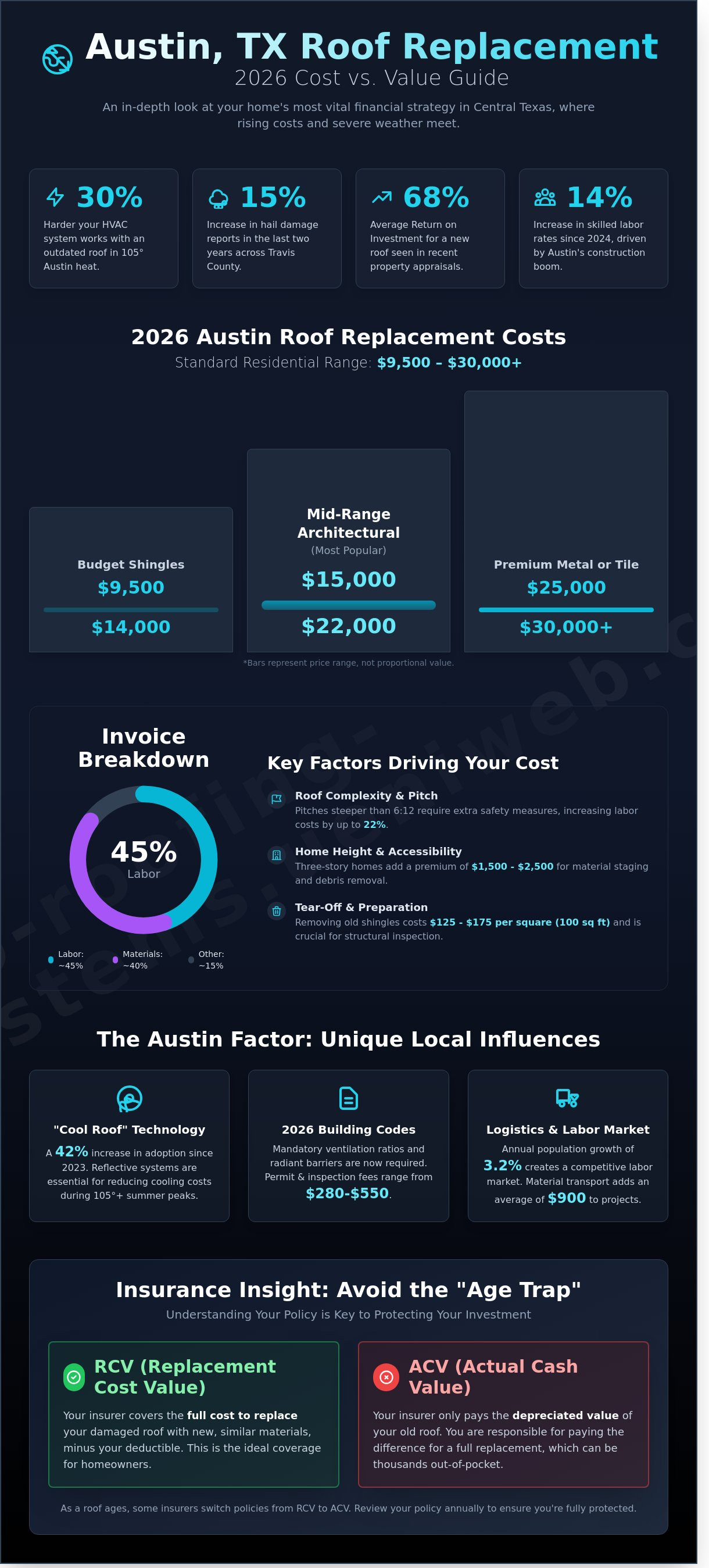
Did you know that an outdated roof can force your HVAC system to work 30% harder during a typical 105 degree Austin July? With local utility rates climbing and hail damage reports increasing by 15% over the last two years, your overhead protection is no longer just a structural necessity. It's a vital financial strategy. Understanding the cost vs value new roof austin 2026 landscape is essential for homeowners who want to protect their investment while the cost of living in Central Texas continues to rise.
You likely feel the pressure of Austin's rising property taxes and the constant anxiety that follows every dark cloud over Travis County. We've spent 35 years providing the expert assurance you need to feel safe and secure in your home. In this guide, you'll discover the real ROI of a 2026 roof replacement, comparing modern material expenses against tangible gains in energy savings and property appraisal. We'll examine how high performance shingles can lower your insurance premiums and ensure your home stays resilient for decades to come.
Key Takeaways
- Understand the 2026 market shifts in Austin and how evolving labor rates directly impact your total roofing investment.
- Identify the primary factors driving expenses, including how material selection and roof complexity influence your final invoice.
- Analyze the cost vs value new roof austin 2026 data to maximize your home's resale potential and long-term energy efficiency.
- Avoid the common "Age Trap" by learning how to navigate insurance policies like RCV versus ACV to safeguard your financial protection.
- Discover how seasoned local expertise ensures your new roof is engineered to withstand unique Central Texas weather patterns for unparalleled durability.
2026 Austin Roof Replacement: Current Cost Trends & Market Realities
Austin's roofing landscape in 2026 reflects a city that continues to expand at a rapid pace. Labor rates for skilled roofing professionals have increased by 14% since 2024, driven by the intense construction boom across Central Texas. Understanding the cost vs value new roof austin 2026 metrics requires looking at both the immediate price and the long-term equity your home gains. While cost represents your initial check, value is the 68% average return on investment seen in recent Travis County property appraisals. Our seasoned team views a new roof as a steadfast shield for your largest asset.
Current pricing for a standard residential roof in the Austin area typically ranges from $9,500 to $30,000. This wide bracket accounts for variations in square footage, roof pitch, and material durability. Fortunately, the supply chain volatility of previous years has vanished. By June 2026, material lead times for standard asphalt shingles have stabilized at approximately 5 to 10 business days. This stability allows us to provide swift response times and precise project scheduling. You won't have to worry about your home sitting exposed for weeks while waiting for a delivery truck.
- Budget Shingles: $9,500 – $14,000
- Mid-Range Architectural: $15,000 – $22,000
- Premium Metal or Tile: $25,000 – $30,000+
Why Austin Costs Differ from the Texas Average
Austin’s 3.2% annual population growth creates a competitive market for seasoned labor. Transporting heavy materials like slate or designer tile through local traffic corridors adds roughly $900 in logistics costs to many projects. We also see a 42% increase in "cool roof" technology adoption compared to 2023. These reflective systems are essential for Central Texas homeowners looking to reduce cooling costs during 105-degree summer peaks. They offer a resilient solution that performs at its best year-round.
The Role of 2026 Local Building Codes
The City of Austin adopted updated energy efficiency standards in early 2026. These regulations mandate specific ventilation ratios and radiant barrier installations that were optional just three years ago. Following these codes is vital for your home’s legal standing and safety. Current permit fees and inspection costs in Austin range between $280 and $550. Investing in a code-compliant system ensures your roof remains a durable asset while safeguarding your property value during any future sale.
Breaking Down the Invoice: What Drives Roof Costs in Central Texas
Every Austin homeowner wants to know exactly where their money goes. Understanding the breakdown helps you evaluate the true cost vs value new roof austin 2026. Three core factors dominate your invoice: materials, labor, and the specific complexity of your home’s architecture. In the current market, labor accounts for approximately 45% of the total project cost. This is driven by a 6% increase in specialized trade wages across Travis County since early 2025.
The physical characteristics of your roof dictate the number of man-hours required. When a roof pitch exceeds a 6:12 steepness, crews must use specialized safety harnesses and scaffolding. This extra equipment and slower movement can increase labor costs by 22% compared to a standard low-slope home. Height also plays a role; three-story homes require more time for material staging and debris removal, often adding a $1,500 to $2,500 premium to the base estimate.
Preparation is just as vital as the installation itself. A full tear-off of old shingles is necessary to inspect the structural integrity of your home. Removing a single layer of asphalt shingles typically costs between $125 and $175 per square (a 100-square-foot area). Beyond the shingles, your invoice will include essential "jewelry" components:
- Flashing: Critical metal seals around chimneys and walls that prevent 90% of common household leaks.
- Gutters: New 6-inch seamless aluminum gutters currently average $11 to $16 per linear foot in Central Texas.
- Ventilation: Proper ridge vents ensure your attic doesn't reach 150 degrees during an Austin July.
Material Tiers: From Asphalt to Standing Seam
Material choice is the most significant variable in your investment. While basic 3-tab shingles are nearly obsolete in 2026, Architectural (Dimensional) shingles remain the standard for durability and value. For those seeking a permanent solution, standing seam metal roofing prices have stabilized at $13 to $19 per square foot. While this is a 15% increase from three years ago, the reflection of UV rays provides a steadfast defense against the Texas sun. Premium synthetic slate offers an even higher tier of protection, designed to withstand the 2-inch hail that frequently hits the Hill Country.
Roof Complexity and Hidden Structural Costs
Architectural details like skylights, dormers, and multiple valleys add beauty but require expert precision. Each skylight requires a specialized flashing kit, typically adding $600 to $900 per unit to the project. Our seasoned roofing specialists always prioritize the health of your roof deck. Data from 2025 shows that 18% of Austin roof replacements reveal rotted plywood that must be replaced before the new shingles are laid. We use high-performance synthetic underlayment instead of traditional felt to ensure your home stays dry even during intense spring thunderstorms.
Calculating the Real Value: ROI, Resale, and Energy Efficiency
Analyzing the cost vs value new roof austin 2026 requires looking beyond the initial invoice. In the high-stakes Austin real estate market, a fresh roof acts as a powerful signal of home health to savvy buyers. Homeowners in neighborhoods like Circle C or Mueller often find that a new roof eliminates the "inspection hurdle," which prevents aggressive price renegotiations that can cost sellers $15,000 or more during closing. In 2026, the average percentage of cost recovered for a new roof during a home sale in the Austin metropolitan area is 68.2%.
A new roofing system provides immediate curb appeal that builds buyer confidence from the moment they pull into the driveway. It suggests the property has been maintained with expert care, reducing the perceived risk of future water damage or mold issues. This sense of security often leads to faster offers and more competitive bidding wars in a market where move-in readiness is a premium commodity.
The Energy Efficiency Bonus
Austin's summer heat is relentless, but modern roofing technology offers a steadfast defense. "Cool Roof" shingles use advanced reflective granules to bounce solar radiation away from the attic space. When paired with proper ridge vents and soffit airflow, these systems reduce attic temperatures by up to 30 degrees during July peaks. This efficiency reduces HVAC strain and saves a typical 2,200-square-foot Austin home approximately $420 annually in cooling costs. Homeowners can also leverage the federal Energy Efficient Home Improvement Credit (25C), which provides a tax credit of 30% of material costs, capped at $1,200 for qualifying upgrades.
Longevity and Maintenance Value
Choosing the right material is a choice between short-term savings and long-term protection. While a standard architectural shingle roof offers a 20 to 25-year lifespan, premium metal systems provide 50 to 70 years of resilient service. This changes the financial perspective to a "cost per year" breakdown:
- Budget Shingles: $16,000 investment / 20 years = $800 per year.
- Premium Metal: $38,000 investment / 60 years = $633 per year.
Our seasoned professionals recommend preventive maintenance plans to safeguard this investment. Scheduling a professional inspection every 24 months identifies minor flashing issues or storm wear before they turn into expensive repairs. This proactive approach ensures the system performs at its best year-round, maintaining the cost vs value new roof austin 2026 benefits for decades. Consistent care isn't just about repairs; it's about ensuring your roof remains a reliable asset that protects your family and your equity.
The "Age Trap" and Insurance: Protecting Your Investment Value
Many Austin homeowners operate under the dangerous assumption that their insurance policy acts as a total financial safety net. They believe that if a storm hits, the carrier will simply write a check for a brand-new roof. By 2026, this assumption has become a costly misconception. The insurance landscape in Central Texas has shifted significantly, moving away from homeowner-friendly terms toward restrictive payout schedules. Understanding the distinction between Replacement Cost Value (RCV) and Actual Cash Value (ACV) is now the most critical factor in your long-term financial planning.
RCV policies cover the full cost of replacing your roof at current market prices. In contrast, ACV policies only pay for the depreciated value of the materials. If your roof is 12 years old, an ACV policy might only cover 40% of the replacement cost. For a standard 2,500-square-foot home in Travis County, this "age trap" often leaves families facing a $15,000 to $18,000 out-of-pocket bill after a hail event. Evaluating the cost vs value new roof austin 2026 requires a clear-eyed look at your policy's fine print before the next storm season arrives.
Navigating the Texas Roof Schedule
Texas insurers are aggressively implementing mandatory ACV schedules for any roof system older than 10 or 15 years. You should examine your policy declarations page for "hidden" depreciation clauses or "Roof Surface Payment Schedules." These terms allow carriers to reduce your payout based on every year of the roof's life. Our seasoned professionals have seen many residents lose thousands in coverage because they weren't aware their policy converted to ACV automatically upon the roof's tenth anniversary. If your current carrier enforces these strict schedules, it's often a wise investment to switch to a provider offering RCV endorsements, even if the monthly premium is slightly higher.
Storm Resilience as a Value Multiplier
Upgrading to Class 4 impact-resistant shingles is no longer just a luxury; it's a strategic financial defense. These materials are engineered to survive two-inch hailstones that would easily shatter standard shingles. In the Austin market, many major insurance providers now offer premium discounts of 20% to 25% for homes with UL 2218 Class 4 certifications. This discount helps the roof pay for itself over its lifespan. Beyond the immediate savings, a resilient roof prevents secondary damage like water intrusion and mold growth. These secondary issues are often subject to separate, lower coverage limits that can leave you vulnerable. Choosing quality materials ensures your home remains a steadfast sanctuary through the volatile Central Texas weather cycles.
Don't wait for a storm to discover your coverage gaps. Contact our expert team for a comprehensive roof and insurance readiness assessment to safeguard your home’s value.
Choosing Your Austin Roofing Partner: The Pro Roofing Systems Assurance
Selecting the right contractor is the final, most critical variable in your return on investment calculation. Pro Roofing Systems leverages over 35 years of local experience to ensure your cost vs value new roof austin 2026 projections stay accurate. We've seen Austin's market evolve through decades of growth and shifting weather cycles. This deep local history means we don't guess about labor costs or material availability in Travis County. We know exactly what it takes to secure a home against the 2.5-inch hail stones seen in recent spring storms or the relentless 100-degree heat cycles that define our summers.
Many homeowners fall into the trap of selecting the lowest bidder to save on upfront expenses. These "economy" contractors often cut corners on critical components like underlayment or flashing to maintain their margins. While you might save $2,500 initially, the long-term cost of leaks and poor ventilation often exceeds those savings within the first five years. We focus on precision and durability that preserves your home's equity. Our 35-year tenure provides a perspective that national chains lack; we've tracked the performance of various shingle brands through the 2011 heatwave and the 2021 freeze. This data informs every recommendation we make for your property.
The Pro Roofing Systems Quality Promise
Our commitment begins with resilient, high-grade materials. We select shingles and metal roofing systems specifically rated for high UV exposure and the rapid temperature swings common in the Hill Country. Our detailed inspections identify "value-killers" like blocked soffit vents or compromised decking before they escalate into structural failures. We don't just look at the surface; we analyze the entire roofing envelope. This thoroughness ensures your cost vs value new roof austin 2026 assessment accounts for hidden issues that could derail a future home sale. Additionally, we provide 24/7 emergency support, offering a safety net that protects your investment during the most volatile Texas weather events.
Getting Your Free Austin Roofing Estimate
A professional on-site consultation is the only way to get a realistic price for your project. During our visit, we perform a 20-point diagnostic check of your entire roofing system. You'll receive a transparent, itemized quote that balances your immediate budget with the long-term value of a high-performance roof. We don't use high-pressure sales tactics. Instead, we provide the concrete data you need to make an informed decision. You can protect your home today with a free estimate from Pro Roofing Systems to secure your 2026 project pricing and ensure your home stays covered with quality and care.
Secure Your Austin Property Investment
Deciding on a major home improvement requires a clear understanding of the cost vs value new roof austin 2026 market. Industry data shows that high quality, resilient materials can recover over 60% of their initial cost through increased property resale value. You'll also avoid the common 15 year insurance "age trap" that often leads to policy cancellations or reduced coverage in Central Texas. Investing in energy efficient systems helps lower cooling bills by up to 15% during our intense July heatwaves.
Pro Roofing Systems offers 35+ years of Austin roofing expertise to guide you through these financial and structural decisions. Our team provides 24/7 emergency roofing support and specializes in the resilient materials required for our unique climate. We've spent three decades building a reputation for steadfast reliability and unparalleled craftsmanship. You don't have to navigate these complex market realities alone when seasoned professionals are ready to help with your next project.
Get Your Free 2026 Roof Replacement Estimate
We look forward to providing the lasting assurance and quality your Central Texas home deserves for years to come.
Frequently Asked Questions
How much does a new roof cost in Austin, TX in 2026?
In 2026, the cost vs value new roof austin 2026 analysis shows that most homeowners spend between $10,500 and $18,000 for a standard 2,000 square foot asphalt shingle replacement. Premium materials like standing seam metal can push this investment past $25,000. These figures include labor, disposal fees, and high-quality underlayment required to meet current Travis County building codes.
Does a new roof increase home value in Austin?
A new roof provides a substantial return on investment, typically recouping 62% of its cost during a home sale in Central Texas. Real estate data from 2025 indicates that Austin homes with documented roof replacements sell 14 days faster than those with aging systems. Prospective buyers prioritize the protection of a new system, often adding $12,000 to your property's final closing valuation.
What is the best roofing material for the Austin climate?
Class 4 impact resistant shingles and standing seam metal are the superior choices for the local climate. These materials endure the 105 degree summer peaks and frequent hail events common in Central Texas. Choosing a Class 4 shingle can also trigger a 20% discount on your annual homeowner insurance premiums because of its resilient and steadfast design.
Is a metal roof worth the extra cost in Central Texas?
Metal roofs are a wise investment because they last 50 years, which is double the lifespan of traditional asphalt materials. While the initial cost is 2 to 3 times higher than shingles, you'll save 25% on summer cooling costs through superior thermal reflection. This long term protection makes it the most cost effective solution for homeowners planning to stay in their residence for at least 15 years.
How do I know if I should repair or replace my Austin roof?
You should consider a full replacement if more than 25% of your roof surface shows signs of granular loss or wind damage. If your shingle system is over 15 years old, simple repairs often fail to provide lasting assurance. Our seasoned professionals recommend a full inspection to check for structural deck rot that minor patches won't fix effectively.
Will insurance cover my roof replacement after an Austin hailstorm?
Most Texas insurance policies cover replacement if a professional identifies functional damage from hail at least 1 inch in diameter. You typically have 365 days from the storm date to file a claim and secure your settlement. We provide expert documentation to ensure your carrier receives the precise evidence needed to process your claim fairly and swiftly.
What is the average lifespan of a shingle roof in Austin?
The average lifespan for asphalt shingles in Austin is 18 years, even if the product carries a 30 year manufacturer warranty. Intense UV exposure and rapid temperature swings accelerate the degradation of the bitumen layers. Regular maintenance can extend this period, but most systems require replacement once they reach the two decade mark to maintain total protection for your home.
What is the "Roof Age Trap" in Texas insurance policies?
The "Roof Age Trap" occurs when insurance carriers switch your coverage from Replacement Cost Value to Actual Cash Value once the roof turns 10 years old. This shift can reduce your claim payout by 40% or more based on depreciation. Understanding this policy nuance is vital for the cost vs value new roof austin 2026 calculation, as it forces homeowners to pay significantly more out of pocket for older systems.
Need a Roof Inspection?
Free, no-obligation inspection from Austin's most trusted roofing team.
Get Free Quote 512-800-7010Explore more roofing tips and guides from our team.
Back to All Articles